
When American and Israeli forces launched a war on Iran at the end of February and Iran bombarded Gulf states with retaliatory strikes, Ahmed Shihab-Eldin, an award-winning Kuwaiti-American journalist, did what he always does: he began reporting.
On March 2, he posted geolocated video — verified by CNN — on Substack of a fighter jet crashing near Kuwait’s Ali Al Salem Air Base. Kuwait hosts the largest U.S. military presence in the Gulf, including at Ali Al Salem Air Base, and serves as a staging ground for U.S. operations across the region. He followed up hours later when it emerged the aircraft was a U.S. plane accidentally downed by Kuwaiti air defenses. Both pilots ejected safely, he reported. The posts had drawn on publicly available material that major international news outlets were already reporting. He also took to X, posting a tweet questioning who was responsible for attacks on Saudi oil facilities.
Then, without explanation, his social media accounts went silent.
The following morning, Shihab-Eldin was arrested in Kuwait, where he was visiting family, and initially held incommunicado by the Ministry of Interior. His lawyers and family worked quietly to secure his release, but in mid-April, after six weeks of imprisonment and no end in sight, they announced his detention, setting off an international outcry. A petition calling for his release circulated online, and Kuwait drew rare international scrutiny for detaining an American who was reporting on a U.S. military event in the country.

His arrest, and the events that followed, offered an unusual glimpse into a transformation unfolding in Kuwait with little international notice. Since Sheikh Meshal al-Ahmad al-Jaber took power in Dec. 2023, Kuwait, long regarded as the Gulf’s only semi-democracy, has dissolved its elected parliament, jailed former lawmakers and activists, and stripped citizenship from an estimated 75,000 of its roughly 1.5 million nationals, according to research compiled by ACMER and corroborated by Kuwaiti academics and rights defenders. Critics and family members put the true number, when counting family dependents, in the hundreds of thousands. Kuwaiti authorities have pursued critics beyond Kuwait’s borders, extraditing writers from Iraq and Malaysia last month, and extraditing a former member of parliament from Saudi Arabia who had been released after completing a sentence over social media posts.
On April 23, after 52 days behind bars, a Kuwaiti court acquitted Shihab-Eldin of the charge of spreading false information, and refrained from pronouncing punishment on the charges of harming national security and misusing his mobile phone, paving the way for his release from prison the following day.
Shortly after his release, Shihab-Eldin disclosed that he and his two sisters had been stripped of their Kuwaiti citizenship, making the journalist and his family among the tens of thousands and possibly hundreds of thousands of Kuwaitis who have been dispossessed in recent years.
“I am free — but many remain behind bars in Kuwait and across the region for speaking the truth,” Shihab-Eldin said in a statement released by his lawyers.
Three years ago, the arrest of a prominent American journalist in Kuwait over a social media post would have seemed inconceivable. Kuwait, a key U.S. ally and the only Gulf state with an elected parliament and a historically vocal opposition, had long been seen as a less repressive outlier in a region of entrenched authoritarianism. But Shihab-Eldin’s detention threw into sharp relief a dramatic authoritarian turn in the tiny oil-rich state.
The Kuwaiti government crackdown has unfolded with remarkably little international notice. While Saudi Arabia and the United Arab Emirates face sustained scrutiny over their rights records, Kuwait’s reversal has drawn limited condemnation from the broader international community, which, by several accounts in this story, has given the government room to escalate.
Shihab-Eldin’s case was not an aberration. It was a symptom of a wider transformation that had been building since a new emir took power in December 2023 and began dismantling the political structures that had long set Kuwait apart from its neighbors.
The Kuwaiti embassy in Washington, D.C. did not respond to requests for comment on the findings of this report at the time of publication.
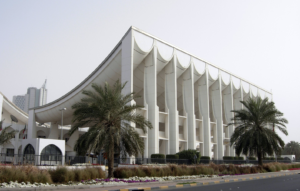
For decades, Kuwait had been the exception. In a Gulf region of closed, autocratic states, it stood out as relatively open with an elected 50-member National Assembly, a vocal opposition, robust public debate, and more civil liberties than neighbors like Saudi Arabia. Although a hereditary emir holds ultimate authority, the National Assembly retained limited but real powers that checked the appointed government.
Kuwait’s parliament has played a crucial role in curtailing repression, including leading opposition to government corruption allegations in 2011-2012, and urging the emir to pardon rights defenders and dissidents in 2021-2022. Tensions between parliament and the royally appointed cabinet frequently produced dramatic standoffs and political gridlock but typically resolved through new elections.
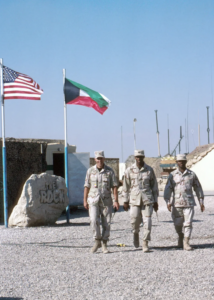
Since Kuwait’s independence in 1961, the country has maintained close relations with the United States and served as a key strategic ally in the region. The relationship was strengthened after the United States helped liberate Kuwait following the Iraqi invasion in 1990. Designated as a major non-NATO ally, Kuwait hosts the largest U.S. military presence in the Gulf – with some 13,500 personnel including contractors – and serves as a key logistics and operational hub in the region.
In the past, the United States had used its leverage to push for democratic progress. Following Kuwait’s liberation in 1991, the United States under President George H.W. Bush used its position as the country’s primary security guarantor to pressure the emir to reinstate the National Assembly, which had been suspended since 1986.
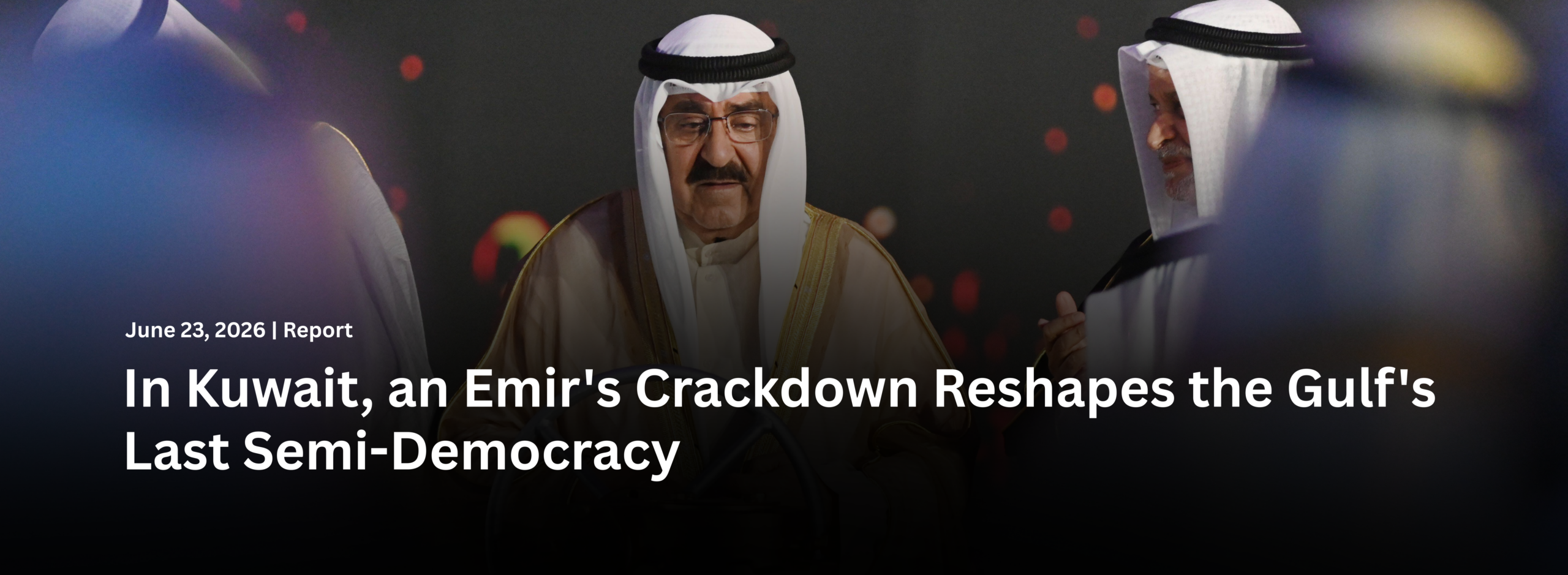
But Kuwait’s exceptionalism as a semi-democracy in the Gulf region began to erode in December 2023, when Sheikh Meshal al-Ahmad al-Jaber assumed power as emir following the death of his half-brother, Nawaf. A former intelligence and security official, the octogenarian ruler immediately struck a nationalistic tone.
In his inaugural address, the emir called for policies to “preserve the Kuwaiti identity” and “promote deserved citizenship for Kuwaitis who believe that Kuwait shall forever remain and loyalty is only to it.” His language would foreshadow the mass revocations of citizenship that would soon follow.
The shift accelerated quickly. In May 2024, just over five weeks after a snap election returned an opposition majority, Emir Meshal dissolved the National Assembly and suspended several articles of the constitution, including the provisions requiring new elections within two months, stating they would be suspended for a period of “no more than four years.” In the absence of parliament, he launched a sweeping crackdown.
When Emir Meshal took office in December 2023, he made the issue of citizenship a centerpiece of his inaugural speech. Standing in front of the National Assembly on Dec. 20, 2023, he called for a review of citizenship cases that involved “those who entered the country unexpectedly and cloaked themselves in nationality without right, those who claimed lineage not their own, or those who hold dual nationality.”
Soon after, Emir Meshal launched one of the most expansive campaigns of citizenship revocations in the region’s recent history. Citizenship has long been contested in Kuwait — the stateless Bidun minority has been denied basic rights for decades — but the scale and speed of the current campaign is new.
Since March 2024, Kuwait has stripped an estimated 75,000 people of their citizenship. Because dependents of these 75,000 people also subsequently lose their Kuwaiti citizenship, the true number is far greater (reportedly more than 285,000).
Gulf human rights groups have reported that the majority of those who had their citizenships revoked were women naturalized through marriage. In late 2024, Emir Meshal amended the constitution to strip foreign-born women of the right to obtain citizenship through marriage, retroactively threatening the status of many who had been citizens for decades. Under the previous law, non-Kuwaiti women married to Kuwaiti men could apply for nationality. Now that pathway has closed and thousands who had long held citizenship began losing it.
People naturalized for “exceptional service to the nation” have also had their citizenships revoked, as well as children of Kuwaiti mothers and non-Kuwaiti fathers, since Kuwaiti law does not automatically grant mothers the right to pass citizenship to their children.
The government has claimed the widespread revocations have targeted those who allegedly obtained Kuwaiti citizenship fraudulently, or those deemed a threat to state security. But according to a Kuwaiti legal expert and academic who requested anonymity for fear of reprisal, cases of citizenship fraud make up less than 5% of citizenship revocation cases. The vast majority have targeted foreign-born women who obtained Kuwaiti nationality through marriage to Kuwaiti men.
“It weighs heavily on me to know that my wife is about to give birth, but there will be no official documents available for the child,” a young father who recently had his citizenship revoked and asked to remain anonymous told ACMER.
 Earlier this year, without warning, he learned through the official gazette that his citizenship had been revoked, without the opportunity to appeal. The man, who had citizenship through his grandfather who was granted his citizenship nearly 50 years ago through his Kuwaiti military service, was subsequently removed from the waiting list for government employment and denied access to social services.
For those who are stripped of their citizenship the practical consequences are real: they are unable to secure legal documents, find it difficult to access healthcare and education services, and are barred from government employment which predominates in Kuwait. The impact of citizenship revocations extends past those who are directly targeted: Children and any relative who gained citizenship through them also lose their citizenship — potentially pushing that figure into the hundreds of thousands.
Authorities have also appeared to use revocations to silence political opponents and cultural figures. On Nov. 9, 2025, Kuwaiti authorities announced they had revoked the citizenship of former Kuwaiti parliamentarian Mohammed al-Muhan, who was part of the opposition bloc, as well as his relatives, and all those who obtained citizenship through him, for allegedly obtaining citizenship from another Gulf nation, referring to Saudi Arabia. Al-Muhan is one of several Kuwaiti opposition politicians who have been targeted by the recent citizenship revocation campaign, along with exiled Ummah party leader Hakim al-Mutairi and Kuwaiti-American activist al-Muthanna al-Zenki.

In November 2024, Kuwaiti newspaper al-Qabas reported that the emir issued a decree to withdraw Kuwaiti citizenship from prominent actor Dawood Hussain and singer Nawal al-Kuwaitia. The brazen targeting of al-Kuwaitia, a legendary Kuwaiti singer and one of the most celebrated figures in Arab music, was unprecedented and signaled that no public figure was beyond the policy’s reach.
Analysts and exiled Kuwaiti academics point to several motivations for the emir’s unprecedented campaign of citizenship revocations. “[One of the] reasons for the citizenship revocations is economic”, said Mohammad al-Matar, a Kuwaiti academic now based in Canada. “[The emir] believes that all of the government spending on public benefits is a waste of money. Thus, if these people are no longer Kuwaitis, we (the state) save money. Maintaining internal stability and saving the state’s money are the top two priorities for him.”
Others point to Emir Meshal’s desire to ‘cleanse’ Kuwait across ethnic lines as another catalyst for the revocations campaign. He has been known to use nativist language, including in May 2025 when he referred to the citizenship revocations campaign as returning “Kuwait to its original peoples, clean and free of the impurities that have clung to it.”
“There is now an obsession over who is a real Kuwaiti, and [there is a view] that Kuwait has been kidnapped by foreigners and must be taken back by real Kuwaitis. This is a clear attack toward both women who gained citizenship from marriage, and tribal, non-urban sects of Kuwaiti society,” said al-Zenki, the Kuwaiti-American activist.
Citizenship revocations have been just one front in a wider campaign to reshape who belongs and who is free to speak out. Following the suspension of parliament, authorities moved swiftly to silence critics — arresting former Members of Parliament, activists, and social media users on sweeping charges of “insulting the emir” or criticizing his dissolution of parliament.
The case of former member of parliament Waleed al-Tabtabie illustrates both the reach of the campaign and the cooperation Kuwait has secured from its Gulf Cooperation Council neighbors. According to court documents obtained by ACMER and sources with direct knowledge of the cases, al-Tabtabie was sentenced in April 2025 to four years in prison by Kuwait’s Court of Cassation, the country’s highest court, over posts on X critical of the emir. In one post following the suspension of parliament he wrote that “it is unacceptable for some countries to interfere in Kuwaiti internal affairs,” inferring that Saudi Arabia and the UAE influenced the emir’s decision to suspend parliament, and called for a “swift return to fully activating the 1962 constitution,” and the restoration of the National Assembly’s powers.
After serving two years in prison, he was released on May 11, 2026, and traveled to Saudi Arabia, where he was promptly detained. The following day, Kuwait issued a statement confirming his extradition, claiming his release had been an administrative error. Authorities claimed he had not completed his sentence.
Other lawmakers targeted in the crackdown include former member of parliament Hamad al-Olayyan who received two years on charges of “overstepping the status of the emir” and “criticizing official orders.” From the Shia minority bloc, former parliamentarian Husain al-Qallaf was also sentenced to two years for “insulting” and “criticizing the emir,” according to court documents obtained by ACMER.
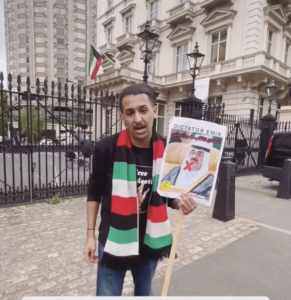
The crackdown has not been limited to former lawmakers. It has extended to online commentators, academics, cultural figures, and ordinary social media users, including those outside Kuwait. Online commentator Salman al-Khalidi was stripped of his citizenship in April 2024 and sentenced in absentia to 21 years in prison for peaceful online expression and his work with the Kuwaiti Refugees Association. Despite having his Kuwaiti citizenship revoked, he was detained in Iraq at the request of Kuwaiti authorities and extradited to Kuwait in January 2025, and a year later, sentenced to 15 years with hard labor. In May 2026, a criminal court overturned that sentence and sentenced him to five years followed by deportation. In May 2025, blogger Musaed al-Musaileem was also extradited from Malaysia where he was seeking asylum and now faces up to 30 years for advocating for human rights online.
In November 2025, Kuwaiti actress Elham al-Fadalah faced prosecution over a leaked recording in which she appeared to criticize the state of Kuwait.
Since the outbreak of the U.S.-Israeli war on Iran, and Iran’s retaliatory targeting of Kuwait, authorities have ramped up their crackdown under the guise of national security. On April 23, 2026, Kuwait’s State Security and Terrorism Court sentenced 17 people to three years in prison and one person to 10 years for allegedly inciting sectarian strife and voicing support for Iran on social media. Nine others were acquitted of other charges, among them Kuwaiti-American journalist Shihab-Eldin.
According to academic Muhammed al-Matar, who lives in Canada, Emir Meshal appears less concerned with Kuwait’s international image than his predecessors — a shift he believes is fueling increasingly brazen crackdowns at home.
As more government critics have left the country, the Kuwaiti government has also increasingly engaged in transnational repression, including targeting individuals in the United States. Al-Zenki, who was born in the United States and grew up between California and Kuwait, said he returned to United States permanently when freedom of expression in Kuwait began to deteriorate. Back in California, he took to social media to exercise his right to freedom of expression and gained hundreds of thousands of followers online for his commentary that was critical of the Kuwaiti government. In an attempt to silence al-Zenki in the United States, Kuwaiti authorities froze his bank accounts and revoked his Kuwaiti citizenship. Today, he continues to receive regular threats online, he said.
“Fahd al-Yousef, [the Kuwaiti minister of interior] personally promised to bring those like me to Kuwait,” he told ACMER. He understood the threat to mean extradition and possible imprisonment.
Kuwaiti authorities’ targeting of al-Zenki — an American citizen living in California — makes clear that their crackdown is no longer confined within Kuwait’s borders. In the absence of meaningful pushback from U.S. policymakers, this reach will only grow.
In less than two years, Kuwait, a country long regarded as the Gulf’s only semi-democracy, has dissolved its elected parliament, imprisoned lawmakers and journalists, stripped an estimated 75,000 citizens of their nationality, and pursued critics across international borders. The speed of this transformation and the scale of the human toll has drawn limited international response.
“Kuwait was known in the Gulf for its democratic potential. The Kuwaiti parliament had a real voice in politics,” Kristin Diwan, a senior resident scholar at the Arab Gulf States Institute in Washington, told ACMER. “With that being lost, it’s an open question what Kuwait will be known for.”
Across the Gulf, since the outbreak of the U.S.-Israeli war on Iran, more than 1,000 individuals have been arrested for expressing views or sharing content, like Shihab-Eldin. Kuwait, like its neighbors, has used the cover of wartime national security to accelerate its crackdown on dissent that predates the conflict, and falling in line with its authoritarian neighbors instead of standing apart from them.
For the United States, Kuwait hosts the country’s largest military presence in the Gulf, and Washington has yet to reckon with what it means to anchor that presence in a country that just jailed an American journalist for reporting on a U.S. military incident and targeted another with transnational repression.
For now, Shihab-Eldin is back in the United States, stripped, like his sisters and many fellow countrymen, of the Kuwaiti citizenship he was born with. He continues to write.